ruth asawa's retrospective exhibition at the san francisco museum of modern art 2025
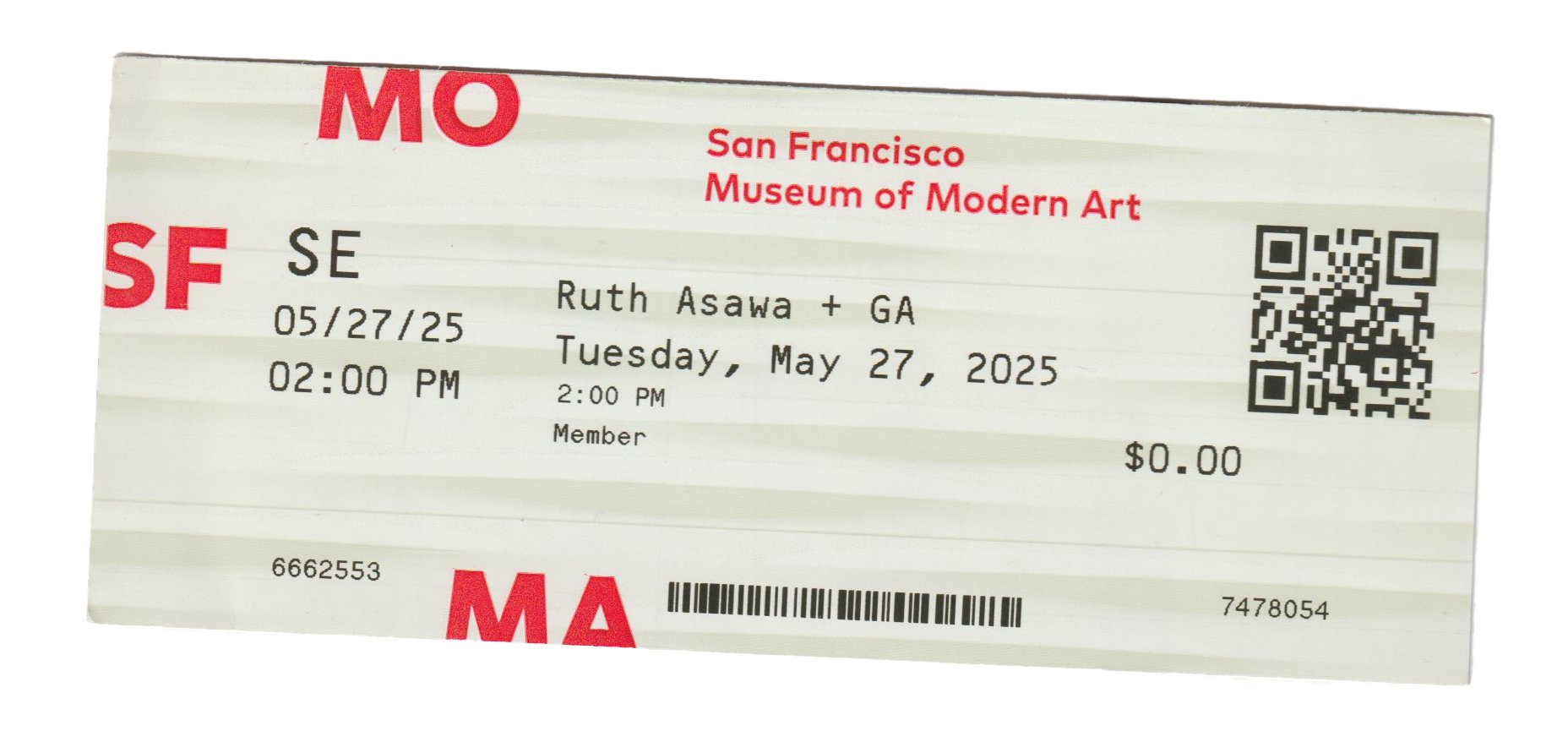
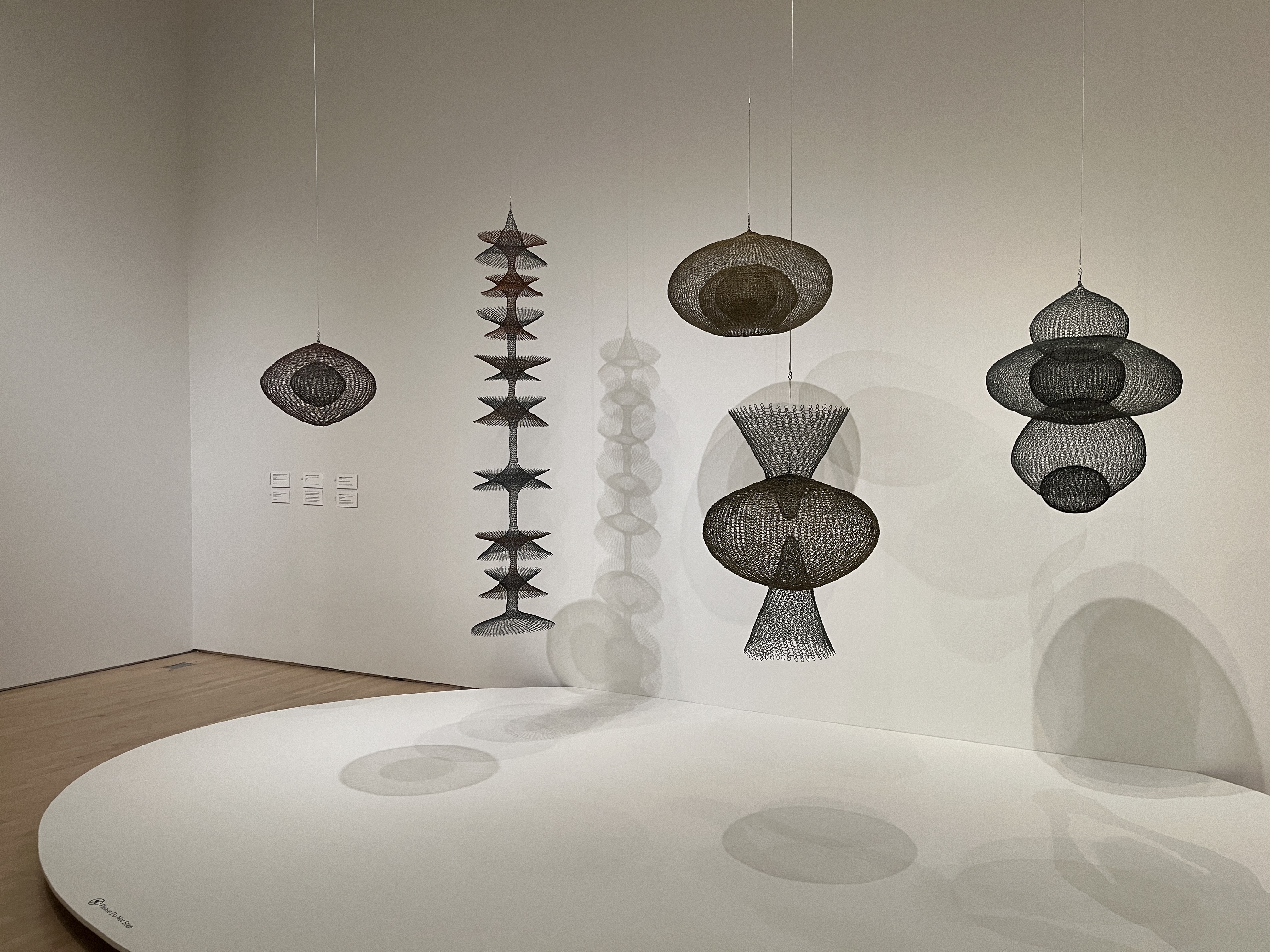
Earlier this year, on a visit to see my younger brother in San Francisco, I went to the Ruth Asawa: Retrospective exhibition on the fourth floor of the San Francisco Museum of Modern Art in downtown San Francisco. The retrospective was a series of rooms filled with a lifetime of artist Ruth Asawa’s work. From what I remember and can piece together from the photos I took, the rooms alternated. There were rooms filled with her more well-known looped-wire sculptures and there were rooms showing sketchbook pages, ink prints on paper, wood, and fabric, wired tree forms, colorful lithographs of flowers, fruits, and vegetables, and prints made from apples and potatoes and college laundry stamps.
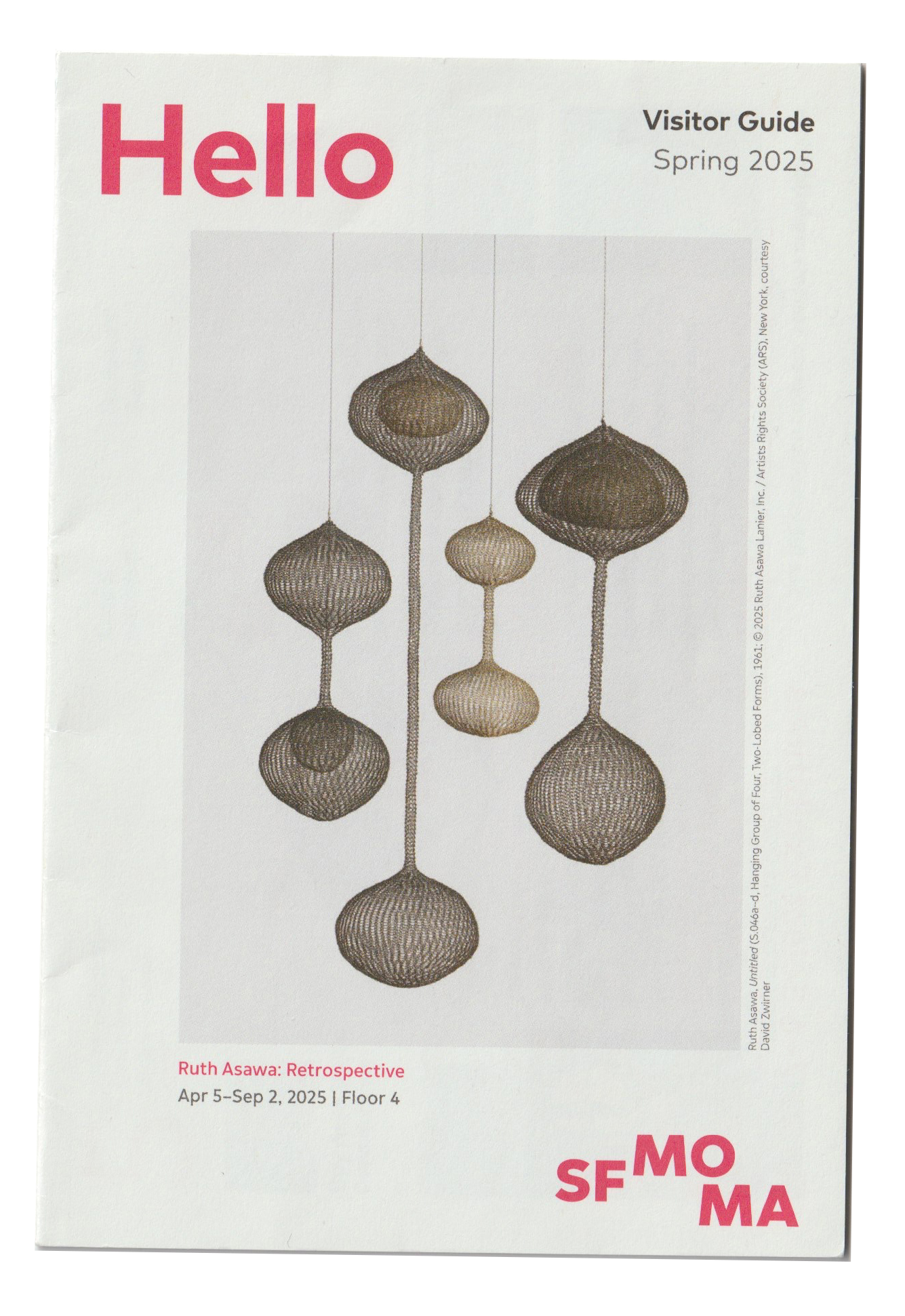
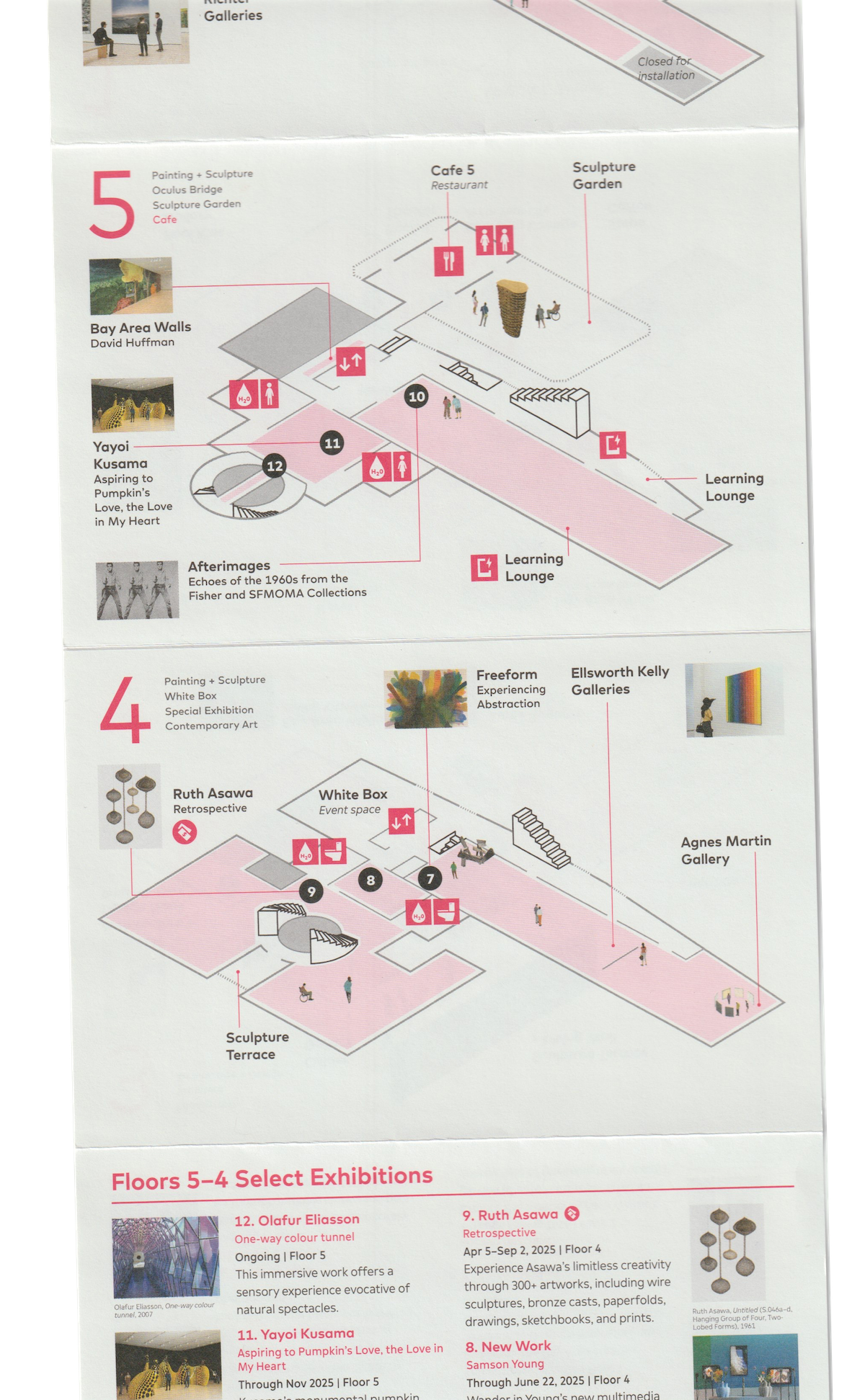
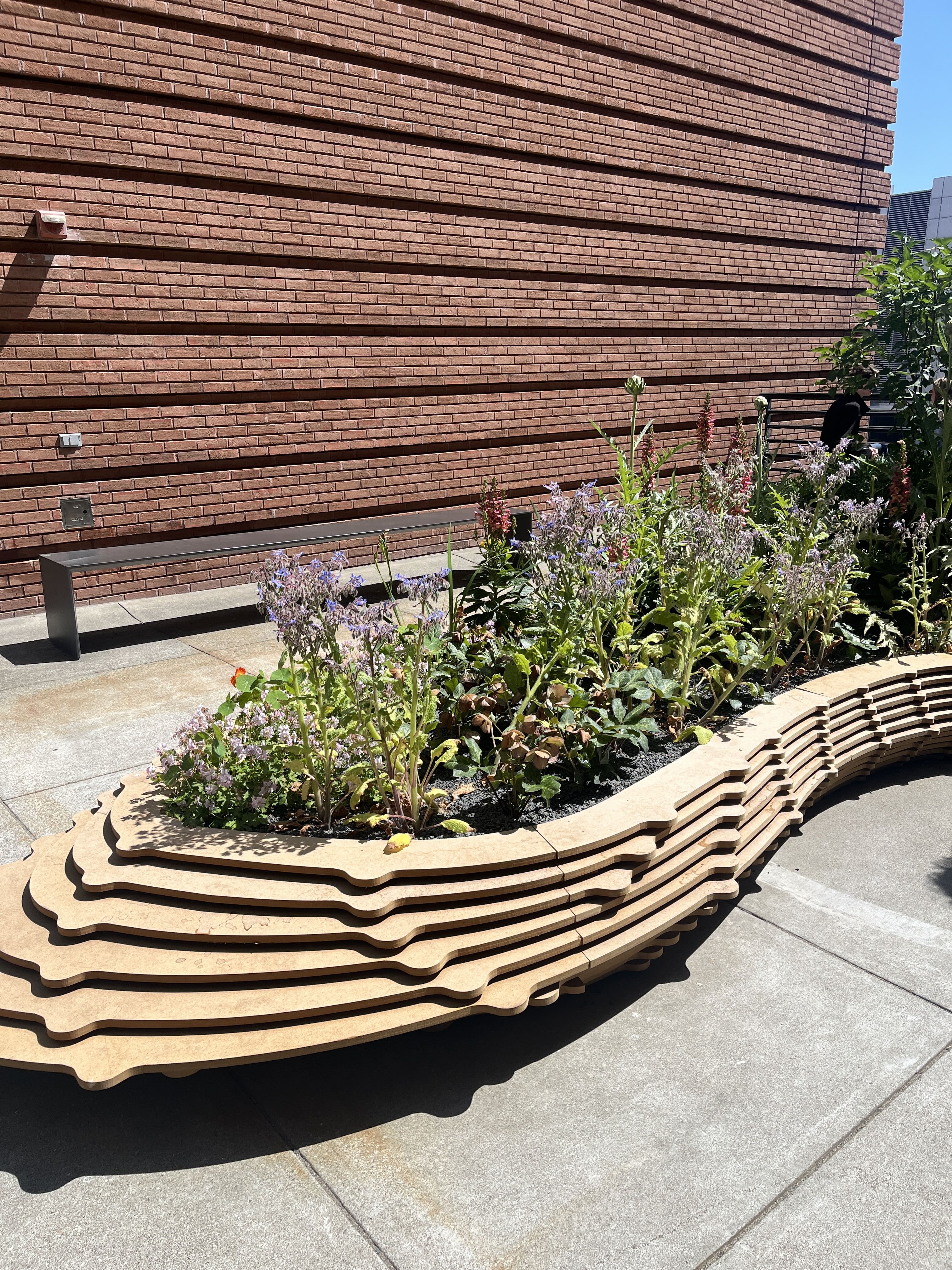
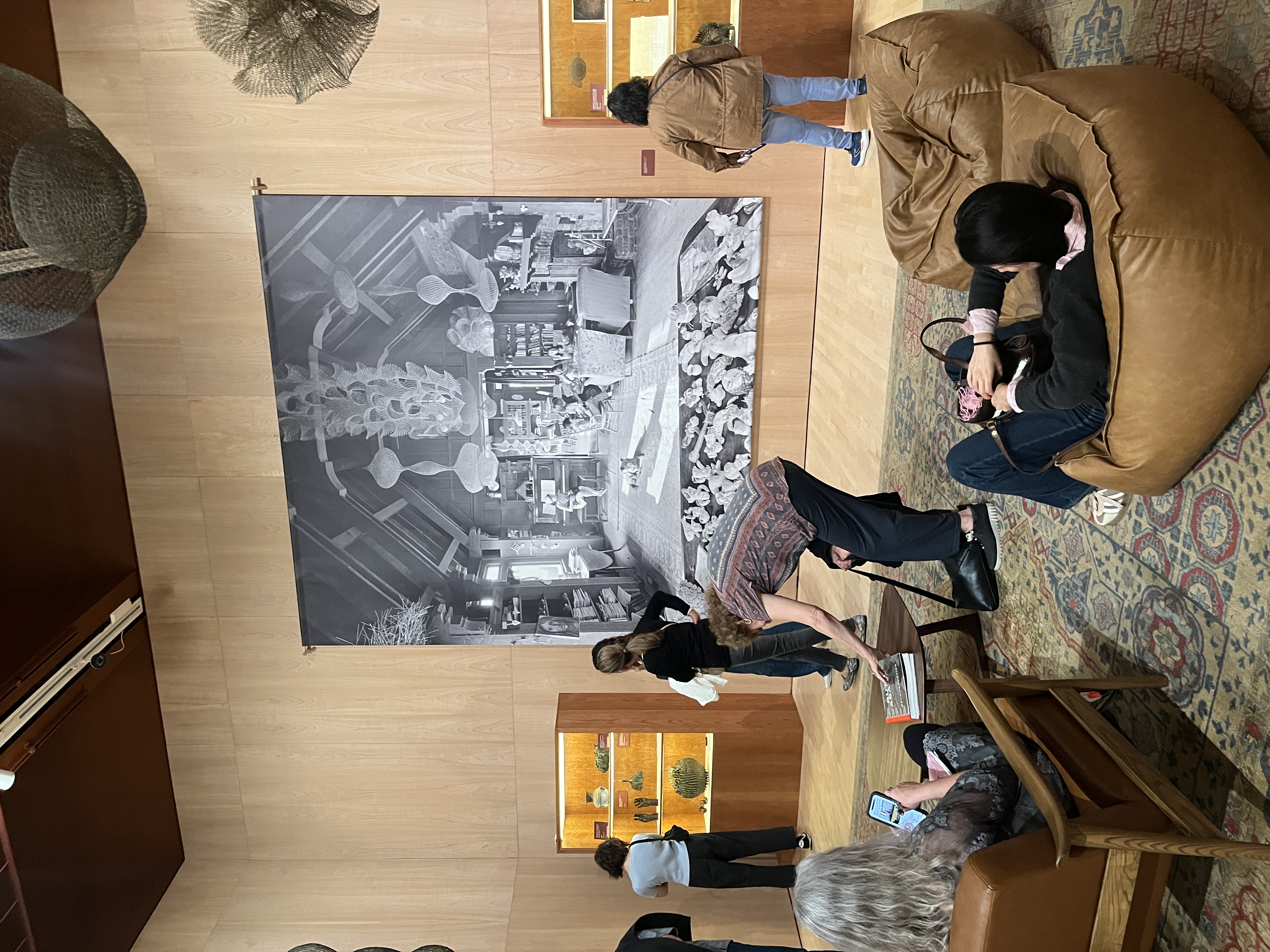
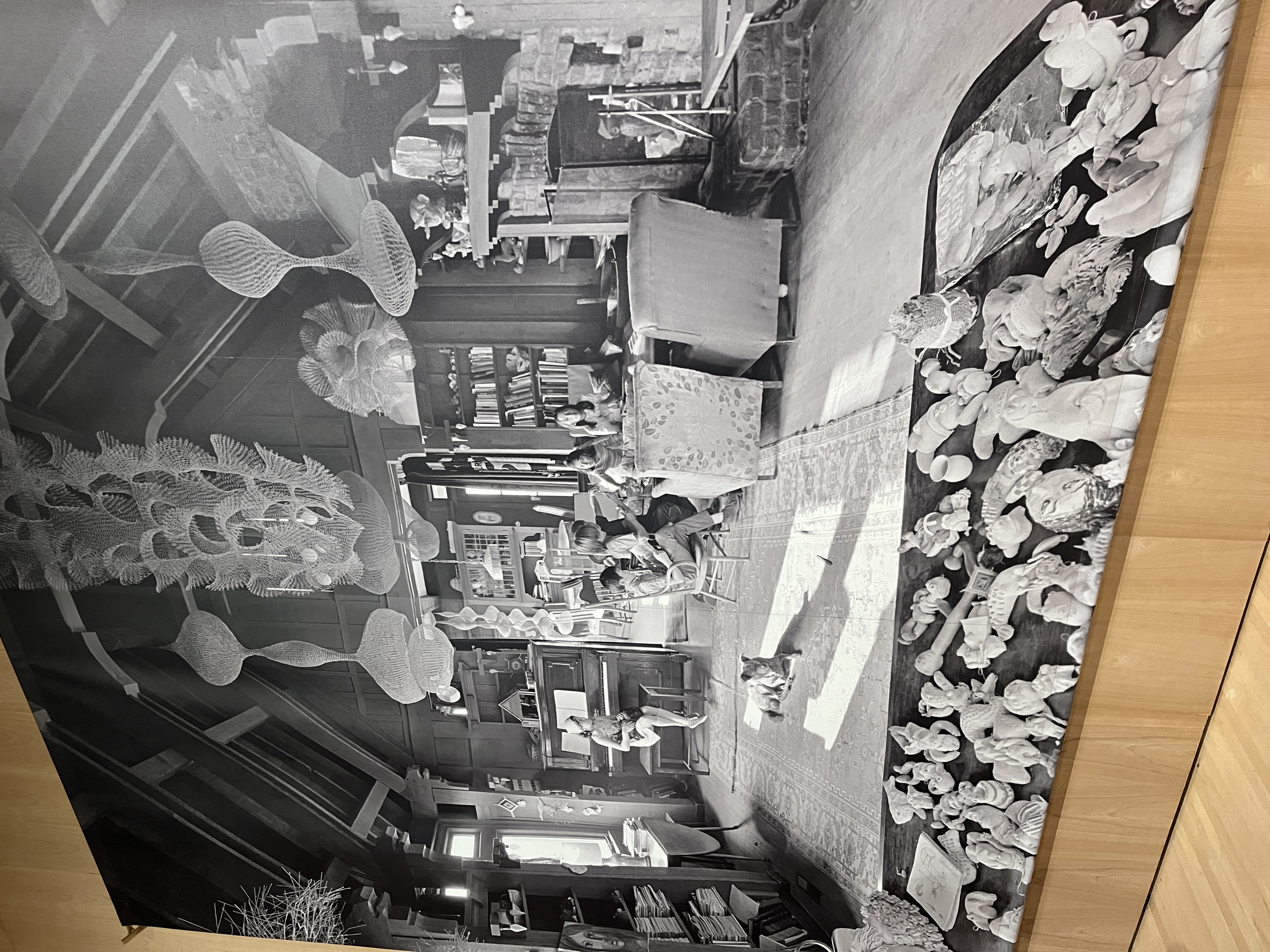
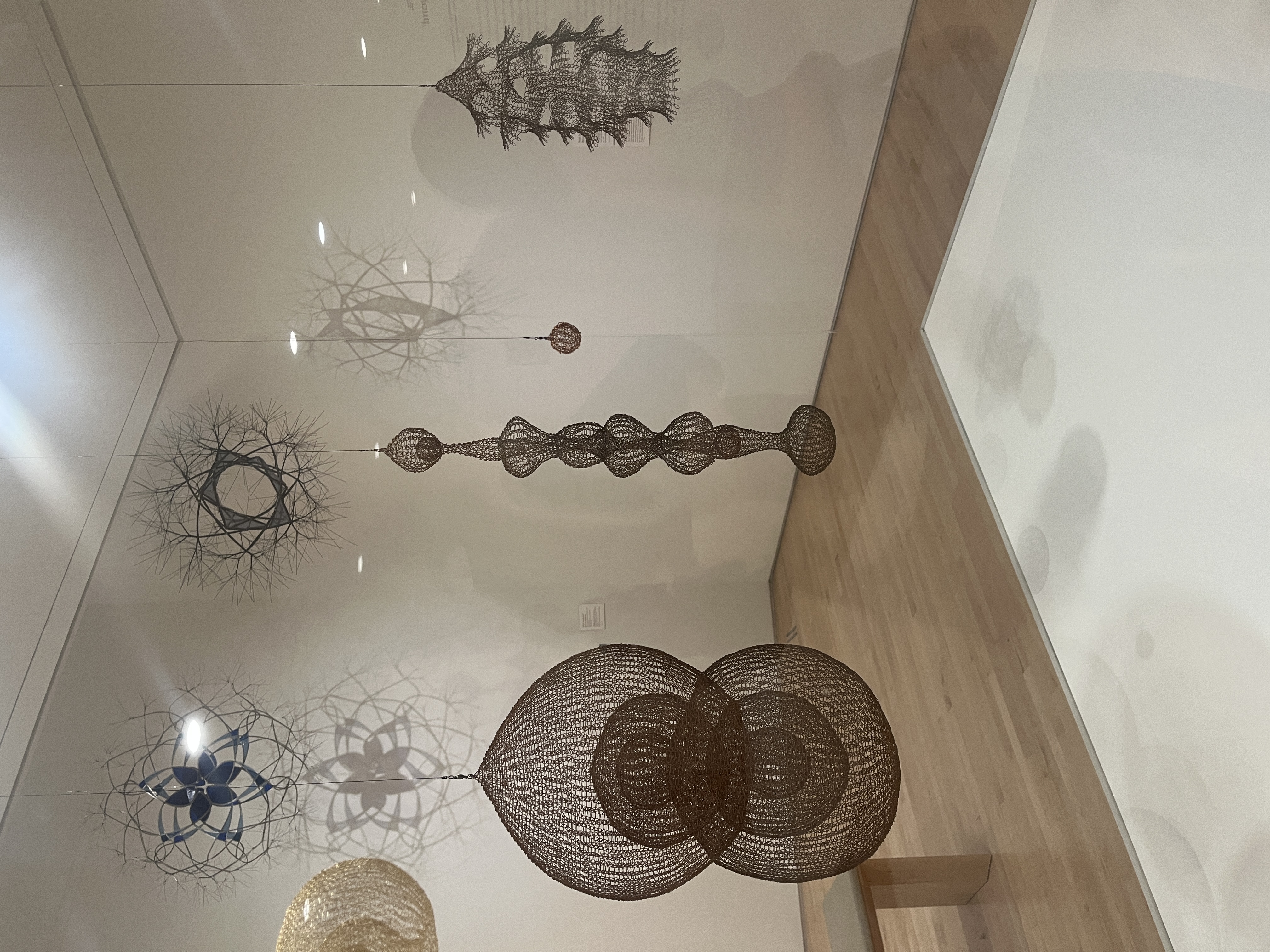
One room, Pedagogy and Public Art, 1960s-1970s, had a large black and white photo on a wall of a bronze mermaid statue fountain Andrea in San Francisco’s Ghirardelli Square. On the opposite wall, there was a rectangular piece of patinated bronze from the Peace March section of San Francisco Fountain hung on the wall that visitors were encouraged to touch. Somewhere among the rooms, there was an insulated orange booth set up where you could go inside and listen to recordings of stories people had recorded about Ruth Asawa. There was also a door to an outside Sculpture Terrace where the garden in the center was inspired by the plants in Ruth Asawa’s garden that she often took inspiration from and sketched. In one of the last rooms, The Living Room, 1960-2013, you enter, and it is her living room from her home in San Francisco’s Noe Valley. There are wooden shelves, a rug, chairs to sit on, and an enlarged 1969 photograph of the Asawa-Lanier living room covers the main wall. In the photo, there are her looped-wired sculptures suspended from the ceiling beams, a table full of baker’s clay figurines, two of her children and some friends, and bright sunlight coming through from a window. In the last room, Later Sculpture, 1970s and Beyond, there is a central case of miniature looped and tied wire sculptures. They are small and suspend delicately. They are the last of the wire sculptures that Ruth Asawa made.
Accompanying the exhibition, the San Francisco Museum of Modern Art and the New York Museum of Modern Art co-edited a 335-page catalog. The publication includes photography of Ruth Asawa’s work, a foreword written by the directors of both museums, acknowledgements, twelve essays with stories and responses to her work, a chronology of Asawa’s life, notes for the chronology, and image credits. Through reading the exhibition book, press on the retrospective, and listening to interview excerpts shared on Ruth Asawa’s website, I learned more about Ruth Asawa’s life.
Asawa was born in 1926 into a family of Japanese immigrant farmers in southern California. She and her siblings grew up doing endless manual labor on the farm before and after school, where she would make hourglass patterns in the dirt with her feet and would unwind wire tags from the vegetable crates and twist them to make figures. In 1942, when Asawa was a teenager, her family was forcibly incarcerated by the United States government and ordered to live at a horse racetrack repurposed as a detention facility in Santa Anita while the Japanese internment camps were under construction. For six months, there was no formal schooling. Three incarcerated Japanese Disney studio artists teach students art. Asawa spends her time drawing and painting. In the fall, Asawa and her family are relocated to an internment camp in Rohwer, Arkansas, a former cotton field, encircled by barbed wire. In 1943, two teachers, Mabel Rose Jamison and Louis Beasley, advocate and support Asawa to leave the camp and continue her education. Asawa moves to Milwaukee to study to become an art teacher at Milwaukee State Teachers’ College, where she meets close friend Elaine Schmitt who tells her about Black Mountain College, an experimental school in North Carolina. In 1945, the Japanese surrender and the war ends. Asawa spends the summer in Mexico at the Universidad Nacional Autonoma de Mexico and the Escuela Nacional de Pintura, Escultura y Grabado. She studies with Cuban furniture designer Clara Porset who also encourages her to apply to Black Mountain College. On her way back to Milwaukee from Mexico, Asawa stops in Arkansas for a joyous reunion with her parents.
The Milwaukee State Teachers’ College refuses to place Asawa in a school for practice teaching and it is difficult for Asawa to find a job due to negative sentiments against the Japanese. Asawa applies to the Summer Art Institute at Black Mountain College where she discovers an attitude towards learning—by doing—that remains with her for the rest of her life. Black Mountain was an unusual, isolated place with Black and Asian students and a community work program where working on the farm was part of the education. After the summer studying painting with Jean Varda and design and color with Josef Albers, Asawa stays at Black Mountain for the next three years. In the summer of 1947, she returns to Mexico to volunteer with the American Friends Service Committee. She teaches art, pottery, and weaving at a school in Toluca. A teacher shows Asawa a technique of wire basketry to create flexible, sturdy egg holders that originated around Toluca. Back at BlackMountain, Asawa experiments with the technique and develops her own method of reversing the direction of the looping and tightening it. From 1946-1949, Asawa takes classes with mathematician Max Dehn, architect, theorist, and inventor Buckminster Fuller, and mentor and artist Josef Albers. Geometry and topology, the study of the properties of shapes that remain unchanged when stretched, twisted, or bent, intuitively become a part of Asawa’s art. Asawa continues with a lifelong practice of her wire construction and looped-wire technique, leading to the multi-lobed, form within a form, tiered looped-wire sculptures, tied-wire sculptures, and miniature wire sculptures shown throughout the retrospective exhibition.

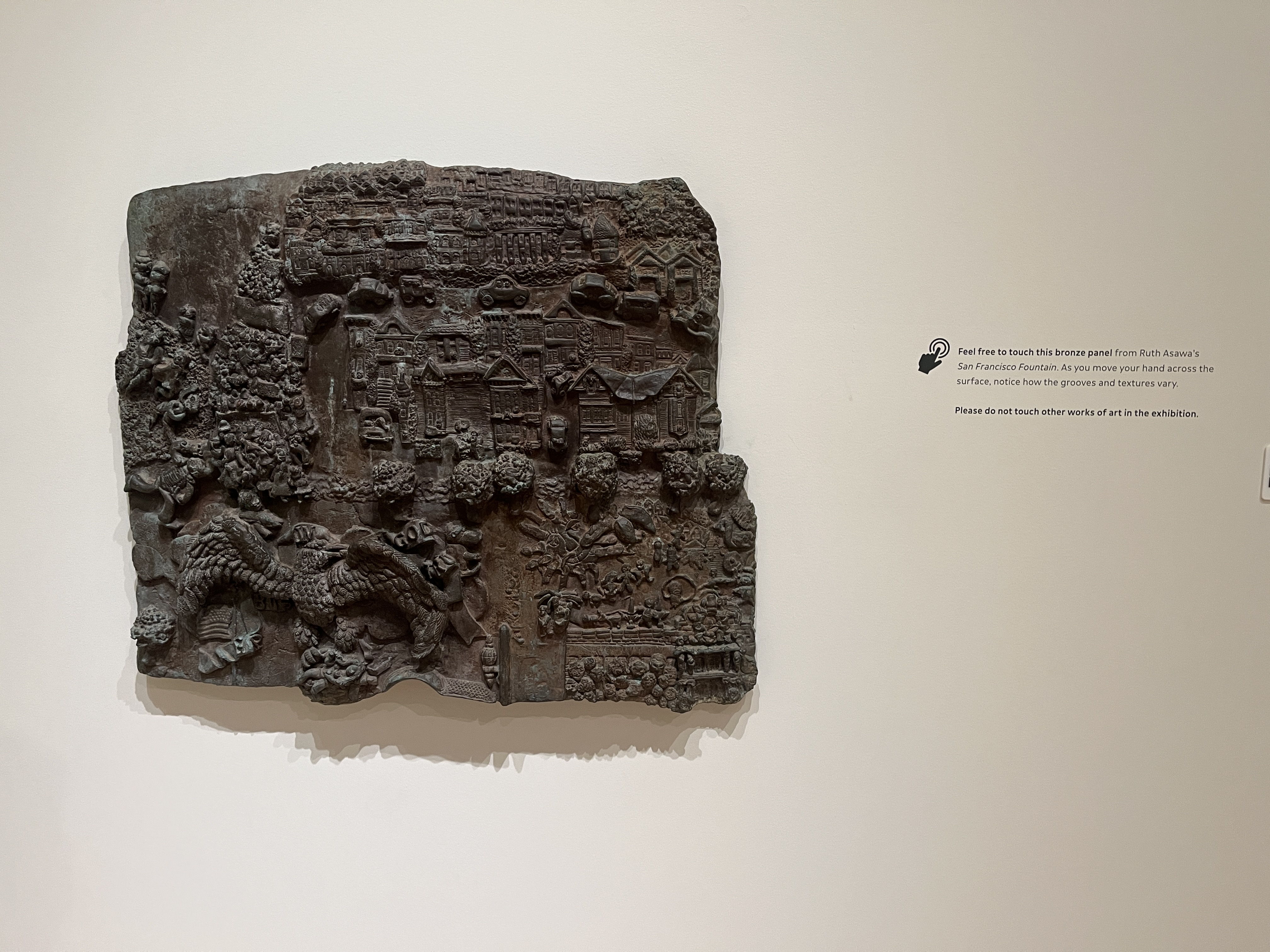

From 1966, Asawa works on dozens of collaborative public art commissions and arts advocacy becomes an important part of her legacy. In the retrospective, there is a piece from the San Francisco Fountain, one of Asawa’s commissions. The art was made collaboratively with 150 local public-school students who helped make the baker’s clay figures, artists Mae Lee, Sally Woodbridge and Aiko Cuneo, and skilled foundry workers who helped cast the clay panels into bronze. Asawa believed art was collective effort and collaboration was a means for teaching and learning from each other. In 1968, Asawa, Sally Woodbridge, and Nancy Thompson start the Alvarado School Arts Workshop at her children’s elementary school and Asawa becomes a member of the San Francisco Arts Commission lobbying for support of arts programs in public schools. The Alvarado School Arts Workshop grows to employ artists, musicians, and gardeners, and involves thousands of parents in public arts education across 50 public schools in San Francisco. Affordable and accessible materials like milk cartons, baker’s clay, and paper folds were used for their capacity to engage children, family, students, community, and art. Material was irrelevant to Asawa. Ordinary material could be made and given a new definition. An artist was someone who could take ordinary things and make them special.
Ruth Asawa’s retrospective exhibition and exhibition’s catalog capture a lifetime of her work, celebrating her evolution and achievements as an artist, while also telling a story of the life experiences and people that shaped her work. The exhibition is now showing in New York on the sixth floor of the Museum of Modern Art until February 7. Next year, the centennial year of Ruth Asawa’s birth, the exhibition will travel to the Guggenheim Museum in Bilbao and the Fondation Beyeler in Basel. A showcase that took five years to make, the retrospective is the largest show measured by number of objects dedicated to a woman artist at the San Francisco Museum of Modern Art and the New York Museum of Modern Art. The exhibition was made possible by Asawa’s family, collectors, curators, scholars, archivists, anthropologists, mathematicians, art historians, artists, exhibition and program management teams, designers, philanthropists, conservators, the San Francisco Museum of Modern Art, and the New York Museum of Modern Art. The collaborative efforts of the retrospective itself reflect Ruth Asawa’s practice.
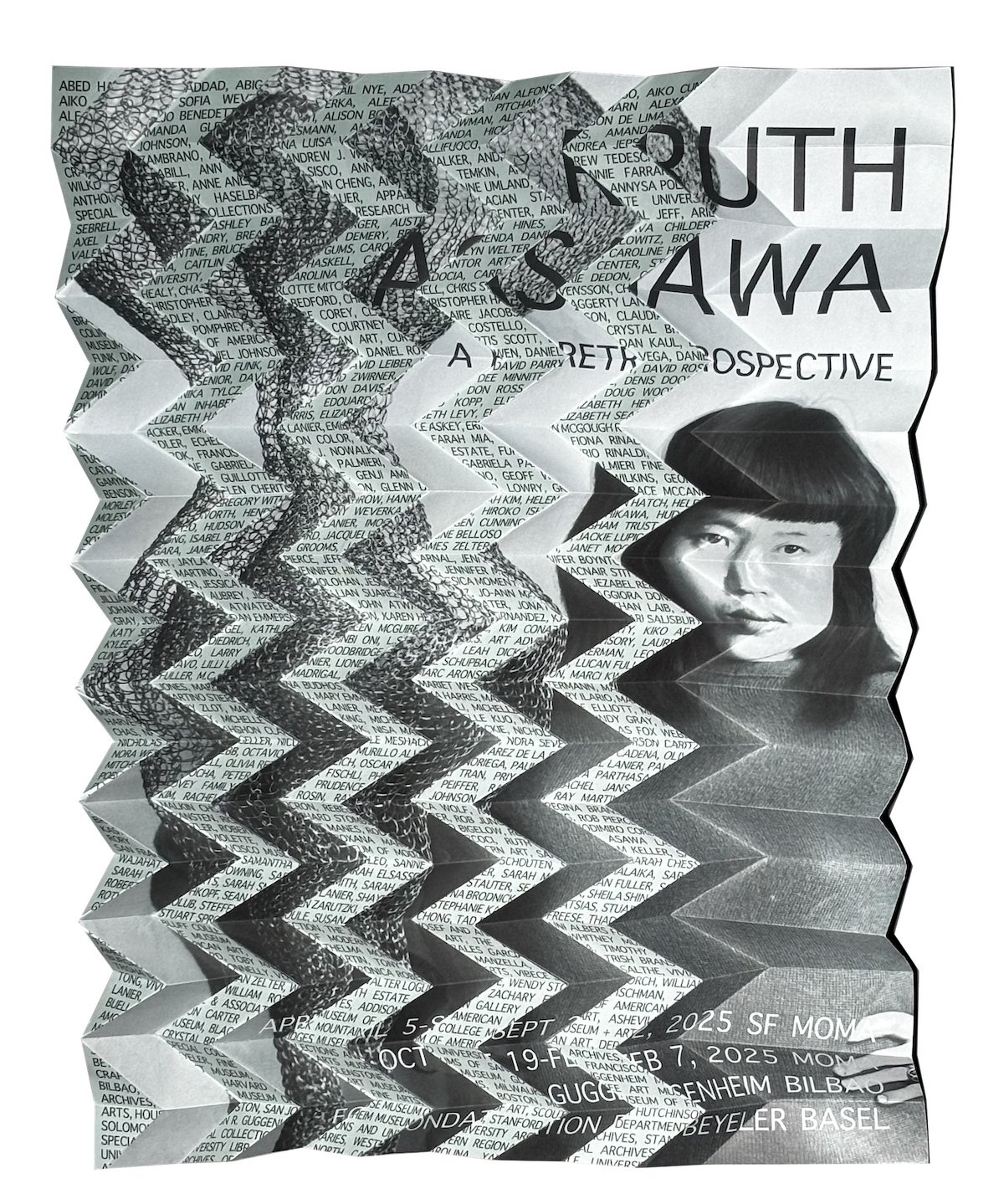
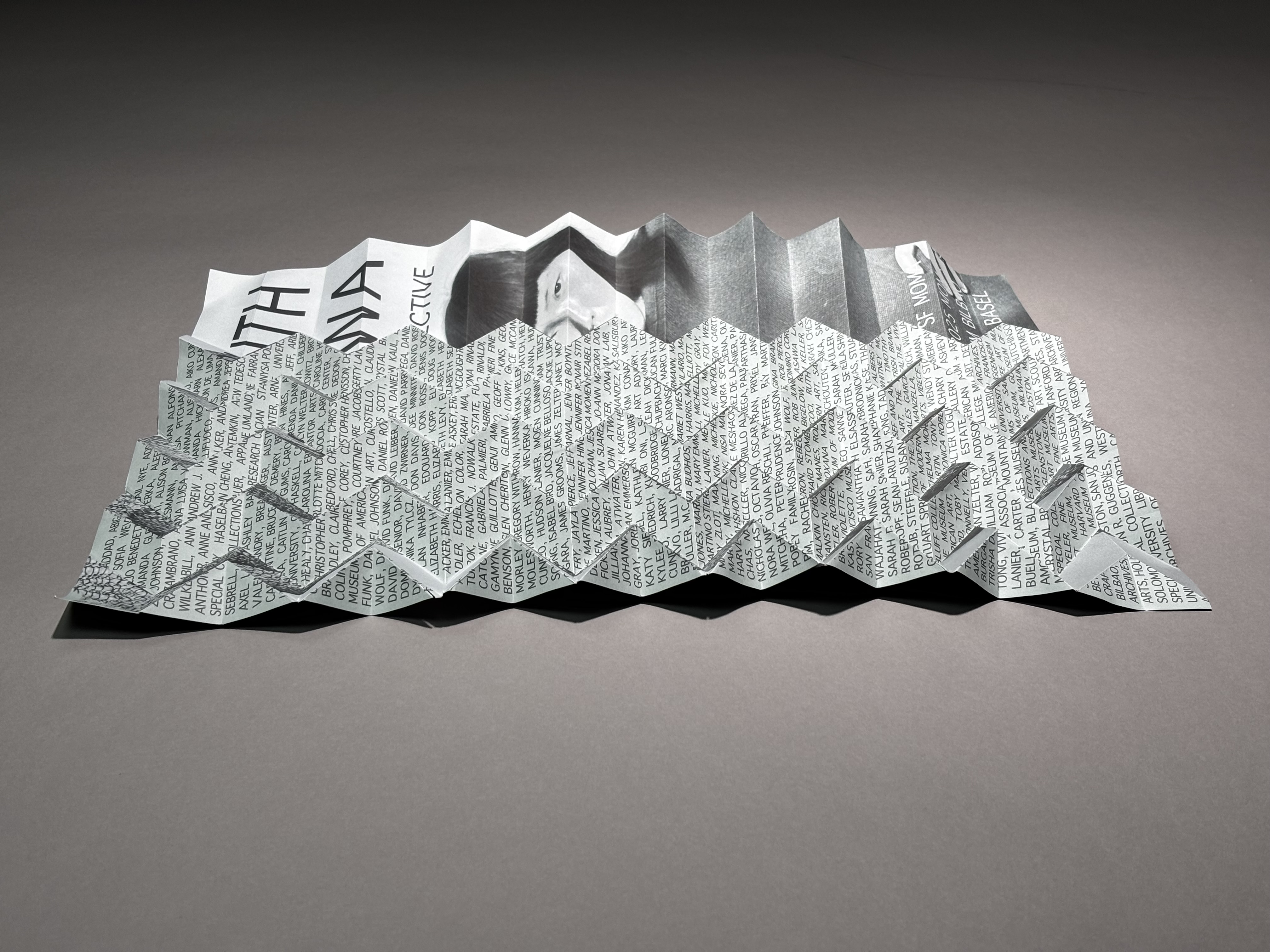
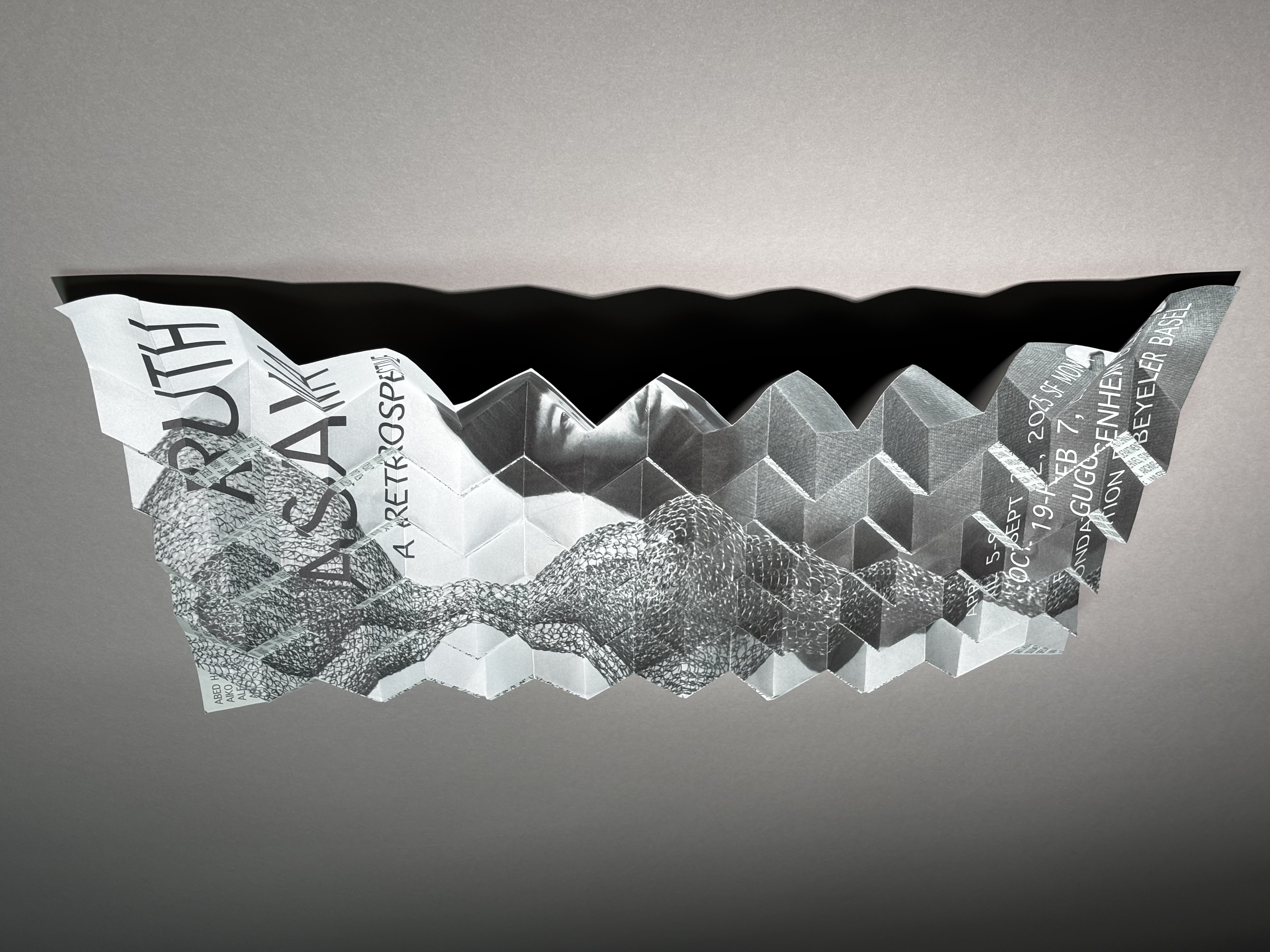
exhibition poster design
As part of this research portfolio, accompanying this writing, I designed an exhibition poster. The poster is made of two overlapping parts. One part is a black and white photo of Ruth Asawa standing next to one of her looped-wire sculptures with the text Ruth Asawa A Retrospective in the top right and information on the exhibition dates and museums in the bottom right. The second part is a block of text with the 800 names of the people and organizations that were named in the acknowledgements of the exhibition. The two parts alternate in zigzag lines, following the folds of the paper. The poster is paper folded with the Miura fold, creating a pattern of repeating parallelograms and giving the paper movement and the ability to expand or contract. The Miura fold and other paper folding techniques were early practices Asawa learned at Black Mountain that taught her how to animate material without destroying its integrity. The folds of the poster animate the two separate parts. If you look straight on, you see both parts. If you look from the left, you will see the block text of names. If you look from the right, you will see Ruth Asawa standing next to her wired sculpture. The overlapping of the sculpture and the names are about how Asawa’s art was also collaboration.